
In 2026, AI is changing contact center work in a very specific way: automation absorbs the simple, repetitive contacts, and what’s left for human agents is more complex, emotionally charged, and higher-risk. Nextiva’s 2026 trend roundup explicitly warns that as AI handles simpler interactions, agents increasingly get “back-to-back complex calls,” which can raise burnout risk if operations don’t adapt.
At the same time, leadership pressure is intense—Gartner reports 91% of customer service and support leaders feel executive pressure to implement AI in 2026. The winning workforce strategy is not “replace agents,” but “redesign the role”: humans become exception handlers, trust builders, and outcome owners, supported by AI for speed and consistency.
For XMCBPO, this creates a clear positioning: AI-enabled, human-led operations with practical safeguards that protect agent wellbeing while improving CX.
Key Benefits

Agents shift from “information retrievers” to “problem solvers”
In an AI-assisted environment, agents spend less time searching systems and more time on:
- complex troubleshooting
- negotiation and de-escalation
- policy interpretation and exceptions
- retention and relationship moments
This role upgrade is essential because AI adoption pressure is rising fast across the industry.

Less burnout when AI removes friction (not just headcount)
AI can reduce burnout when it targets the biggest agent pain points:
- knowledge hunting / tool switching
- repetitive wrap-up work
- inconsistent guidance across queues
IBM notes many contact center employees experience burnout and discusses automation trends that reduce repetitive workload.

Faster onboarding and more consistent performance
With AI-powered guidance (next-best-actions, suggested knowledge, summaries), new hires can ramp faster and experienced agents stay consistent even during peak volume.
That’s crucial in 2026 because the job content is getting “harder per contact” as AI takes the easy tasks.

Better customer trust through “human-in-the-loop” handling for high-stakes cases
Consumer skepticism toward AI-only support remains high. Reporting on a YouGov survey commissioned by Pega highlights low confidence in AI customer service, with strong preference for human help.

Conclusion
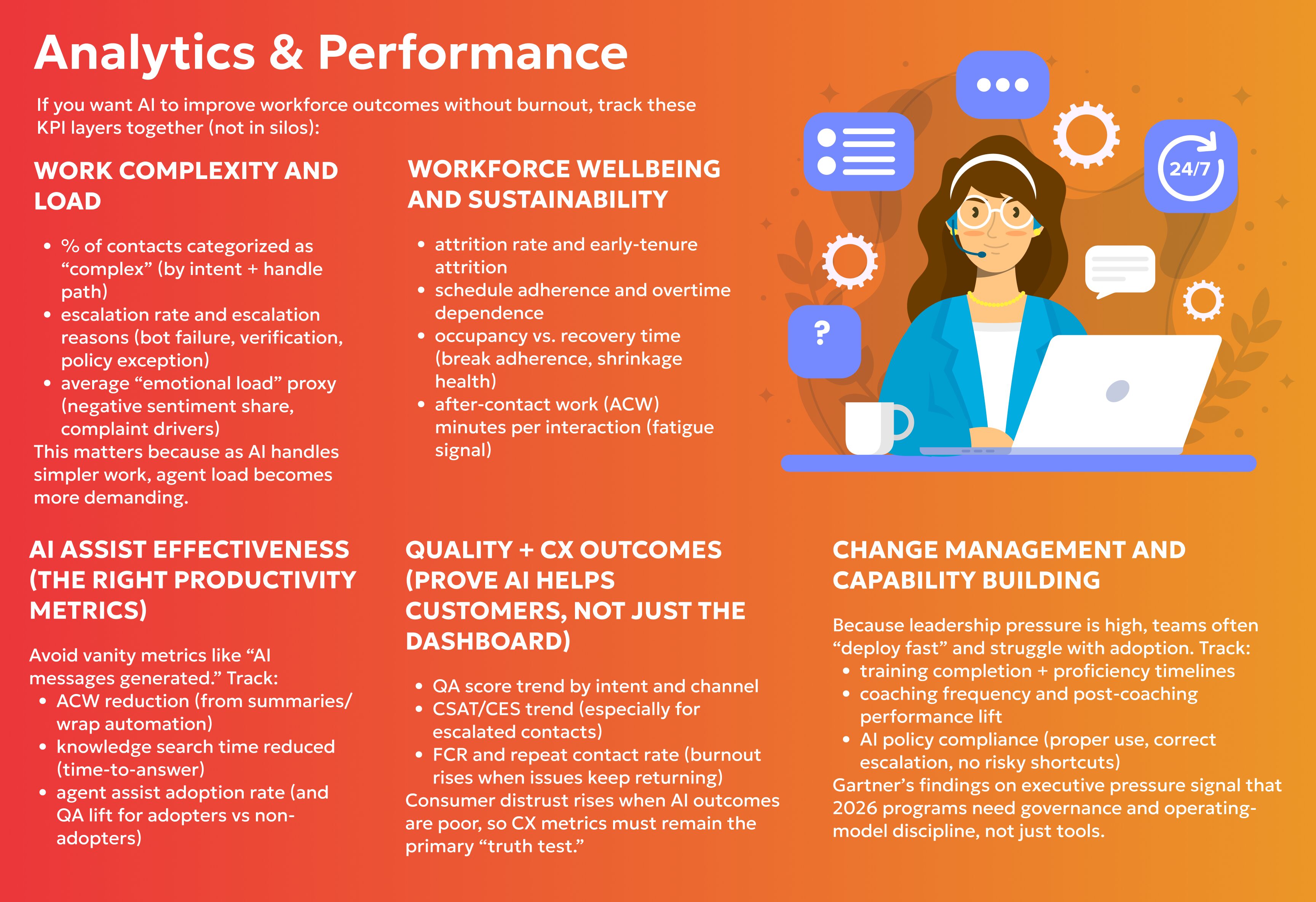
In 2026, AI reshapes agent roles by removing repetitive tasks and concentrating human work into the moments that require empathy, judgment, and trust-building. That can be a win for CX—but it can also increase burnout if leaders don’t redesign staffing, coaching, workflows, and metrics.
The workforce playbook that works is:
- automate friction (knowledge + wrap + workflow steps)
- protect humans from “back-to-back complexity” through smarter routing and scheduling
- coach in shorter loops using real interaction insights
- keep human escalation paths clear to protect trust
For XMCBPO, the opportunity is to deliver an AI-enabled workforce model that improves performance while keeping teams healthy—so productivity gains don’t come at the expense of retention.
References
- Gartner. Gartner Survey Finds 91% of Customer Service Leaders Under Pressure to Implement AI in 2026
- Nextiva. 10 Emerging Contact Center Trends to Know In 2026
- IBM. A guide to contact center automation trends for 2026
- ITPro. Your customers aren’t keen on that customer service chatbot you introduced – here’s why
- Gartner. Customer Service and Support Leaders Must Prioritize Blending Human Strengths with AI Intelligence in 2026


