
In 2026, “great customer service” is increasingly defined by what customers don’t have to do: they don’t need to repeat themselves, chase updates, or even report a problem before it’s handled. Proactive CX is the operating model behind that experience—using signals across channels and systems to predict friction early, prevent avoidable contacts, and intervene with the right message on the right channel at the right moment.
This shift is also being accelerated by executive pressure to deploy AI in service functions to improve outcomes, not just cut costs.
For teams like XMCBPO, proactive CX becomes a practical advantage: it reduces inbound volume, improves customer effort scores, and strengthens client retention by catching issues before they become escalations.
Key Benefits

Fewer “avoidable” contacts (and lower cost-to-serve)
A large share of inbound demand comes from predictable categories: delivery delays, payment/billing confusion, password resets, outages, appointment changes, “where is my order,” and status checks. Proactive detection + outreach can:
- reduce repeat contacts
- reduce queue spikes during incidents
- lower handle time by pre-loading context and recommended actions
Example: If shipment scans show repeated exceptions in a region, notify affected customers with a revised ETA and self-serve options before they open a ticket.

Better CX metrics because you reduce effort (not just respond faster)
Proactive CX directly improves:
- Customer Effort Score (CES): fewer steps to resolution
- CSAT: fewer unpleasant surprises
- NPS / loyalty: fewer “painful moments” across the journey
It’s the difference between “We’re sorry you waited” and “We fixed it before it impacted you.”

Higher trust through transparency and “no-surprise” communication
Customers tolerate problems more when they get:
- early acknowledgement (“We’re seeing an issue…”)
- an ETA or next step
- a clear escalation path to a human
This is especially important as AI gets more involved in service workflows.

Stronger fraud and risk posture (without adding friction everywhere)
Proactive CX isn’t only about service; it’s also about protection. With voice-based channels facing rising AI-enabled fraud risk, leading programs use risk signals to trigger step-up verification only when needed (rather than punishing every caller).

Better agent experience (less chaos, more clarity)
When you detect issues early and route intelligently:
- agents get fewer “angry surprise” calls
- knowledge + next-best-action prompts arrive earlier
- WFM becomes more stable during incidents
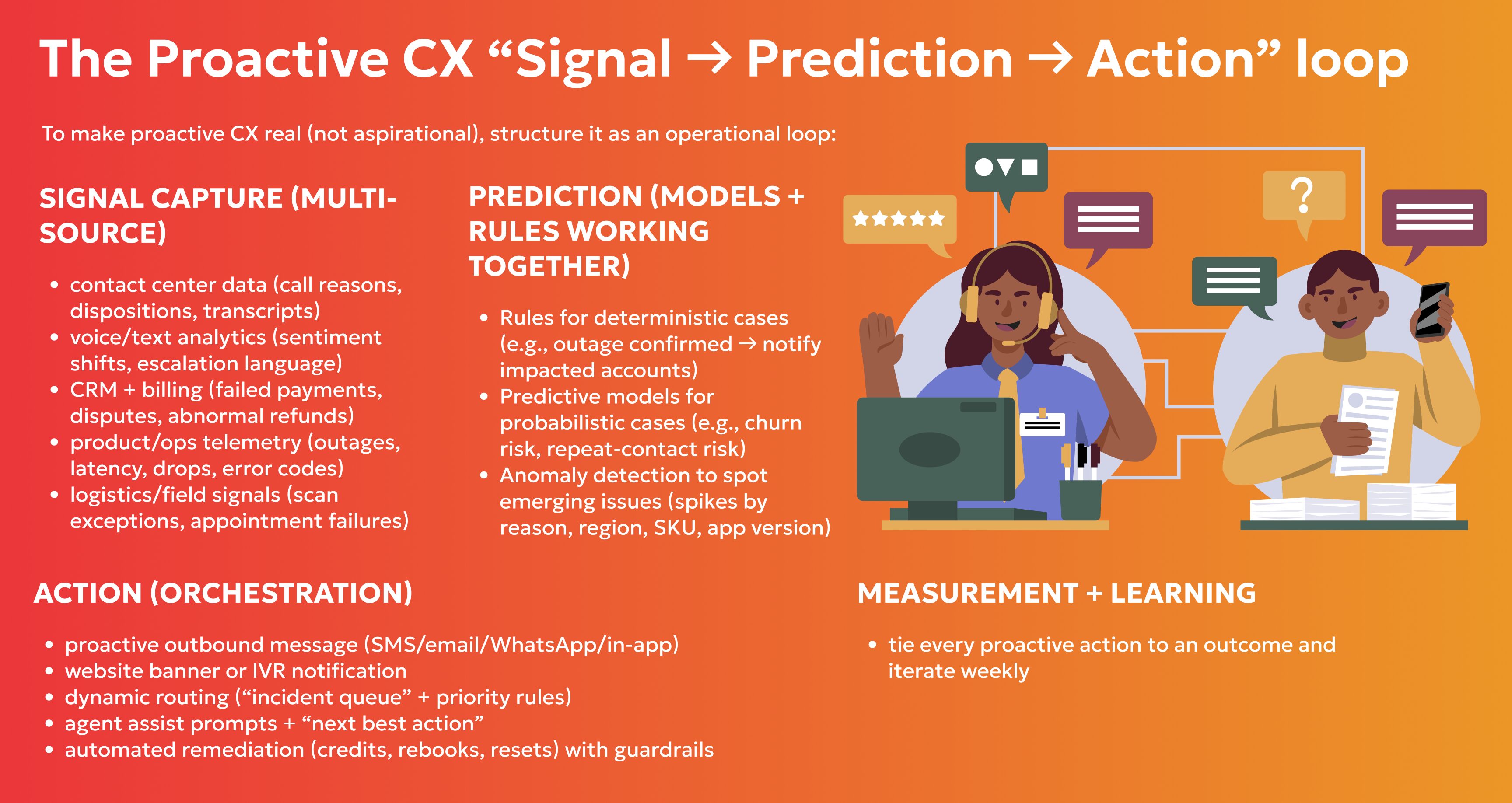

What “good” looks like in 2026 operations
Modern contact center analytics guidance emphasizes consolidating data sources to avoid “dashboard sprawl” and turn analytics into action.
And the market is clearly pushing toward proactive service patterns—industry rollouts increasingly highlight proactive troubleshooting and incident insights as front-line use cases.
For XMCBPO, that translates into a repeatable delivery model:
- Proactive Playbooks (top 10 preventable issues per client)
- Trigger Catalog (signals + thresholds + owners)
- Channel Strategy (“optichannel” style: pick the channel customers prefer for the scenario)
- QA + Governance (prevent over-messaging, ensure compliance, keep a human escape hatch)
Weekly Optimization (A/B test templates, thresholds, routing, and recommended actions)
Conclusion
Proactive CX in 2026 is no longer “nice to have”—it’s a competitive requirement. The winners will be the teams who combine multi-source signals, real-time analytics, and tight operational playbooks to prevent issues before customers complain.
For XMCBPO, the opportunity is straightforward: package proactive CX as an outcomes-led capability—lower avoidable contacts, faster incident containment, better customer effort, and stronger trust—with KPIs that clients can defend in board-level conversations.
If you want, I can also create a Proactive CX Playbook template (1-page) that XMCBPO can reuse per client (signals, triggers, actions, owners, KPIs).
References
- Gartner Press Release (Dec 17, 2025): Customer Service and Support Leaders Must Prioritize Blending Human Strengths with AI Intelligence in 2026
- TTEC: Contact Center Trends 2025 and CX Trends 2026
- TTEC: Real-Time Speech Analytics to Power Voice of the Customer Insights
- Sprinklr: Predictive Analytics in Customer Service (Feb 19, 2025)
- ITPro (Mar 2026): Salesforce Agentic AI tools enabling proactive customer service use cases
- TechRadar (late 2025): AI voice fraud and contact center risk signals
- AmplifAI (Jan 6, 2026): Call Center Analytics—data sources and operational use


