
Traditional omnichannel aimed to be everywhere. In 2026, that’s no longer the win. Customers don’t want more channels—they want the right channel, at the right moment, with full context. That’s the promise of optichannel: choosing the most effective channel for each interaction based on intent, urgency, customer preference, and journey stage.
This shift matters even more as AI expands. When automation loops, blocks access to humans, or forces customers to repeat themselves, trust erodes—so “optimal channel design” becomes a core CX differentiator, not a UX detail. For delivery partners like XMCBPO, optichannel is a practical way to improve CX and efficiency without “channel sprawl.”
Key Benefits

Less customer effort, fewer repeats
Optichannel reduces friction by routing customers to the channel most likely to resolve the issue on the first try—for example:
- simple requests → self-service or messaging
- complex issues → live agent (voice/video)
- urgent account problems → priority queue + human escalation
The result is lower customer effort, fewer transfers, and fewer repeat contacts.

Higher CX trust with clearer escalation paths
Customers don’t hate AI—they hate wasted effort (loops, dead ends, repeating details). Optichannel designs solve this by making escalation rules explicit:
- “Try bot first” only when confidence is high
- “Talk to a human” always available for high-risk or emotional cases

Better ROI than “add another channel”
Many teams add channels and dilute quality. Optichannel flips the model: master fewer, perform better, and expand only when the experience is consistent.

Stronger agent experience and productivity
Optichannel reduces context switching by:
- keeping customer history unified
- preventing channel ping-pong (chat → email → call)
- sending agents the right interactions with the right data
For XMCBPO, this supports faster ramp, cleaner QA, and more stable service levels across programs.

Conclusion
In 2026, “omnichannel” is evolving into optichannel: not being everywhere, but being effective everywhere you choose to play—with smart orchestration, clean handoffs, and human escalation that protects trust.
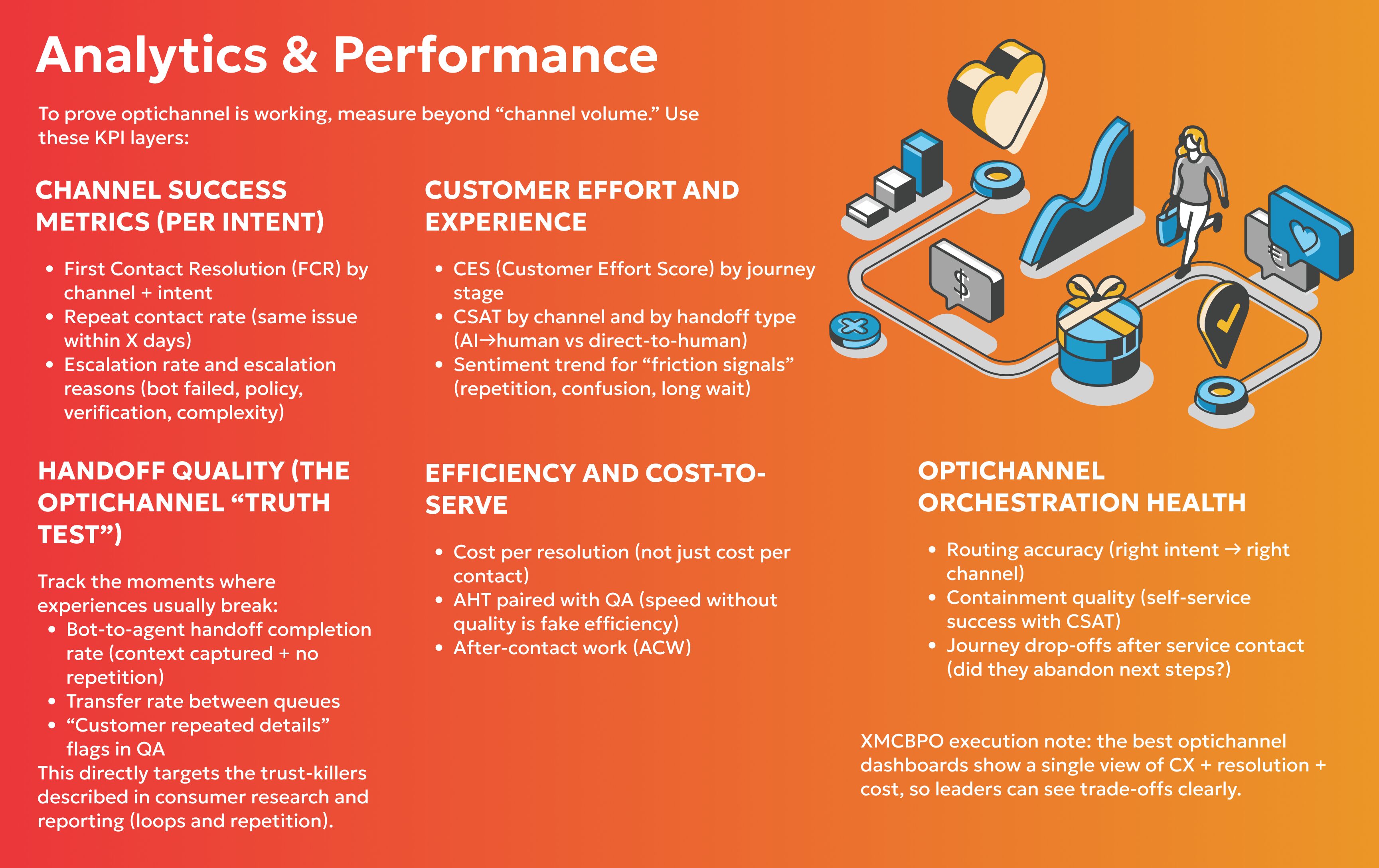
For organizations implementing optichannel journeys, XMCBPO can help operationalize the model—standardizing routing rules, training agents for channel-specific excellence, tightening QA, and building performance reporting that proves real CX gains (not just channel expansion).
References
- Chatwoot. The age of “Optichannel” customer engagement: what is it, and how to approach it?
- Loxon. The next level of customer experience: Optichannel communication
- Corebiz. Optichannel: The New Frontier of Customer Experience
- ITPro. Your customers aren’t keen on that customer service chatbot you introduced – here’s why
- Support Your App. Call Center Trends 2026: AI, CX & Outsourcing


