
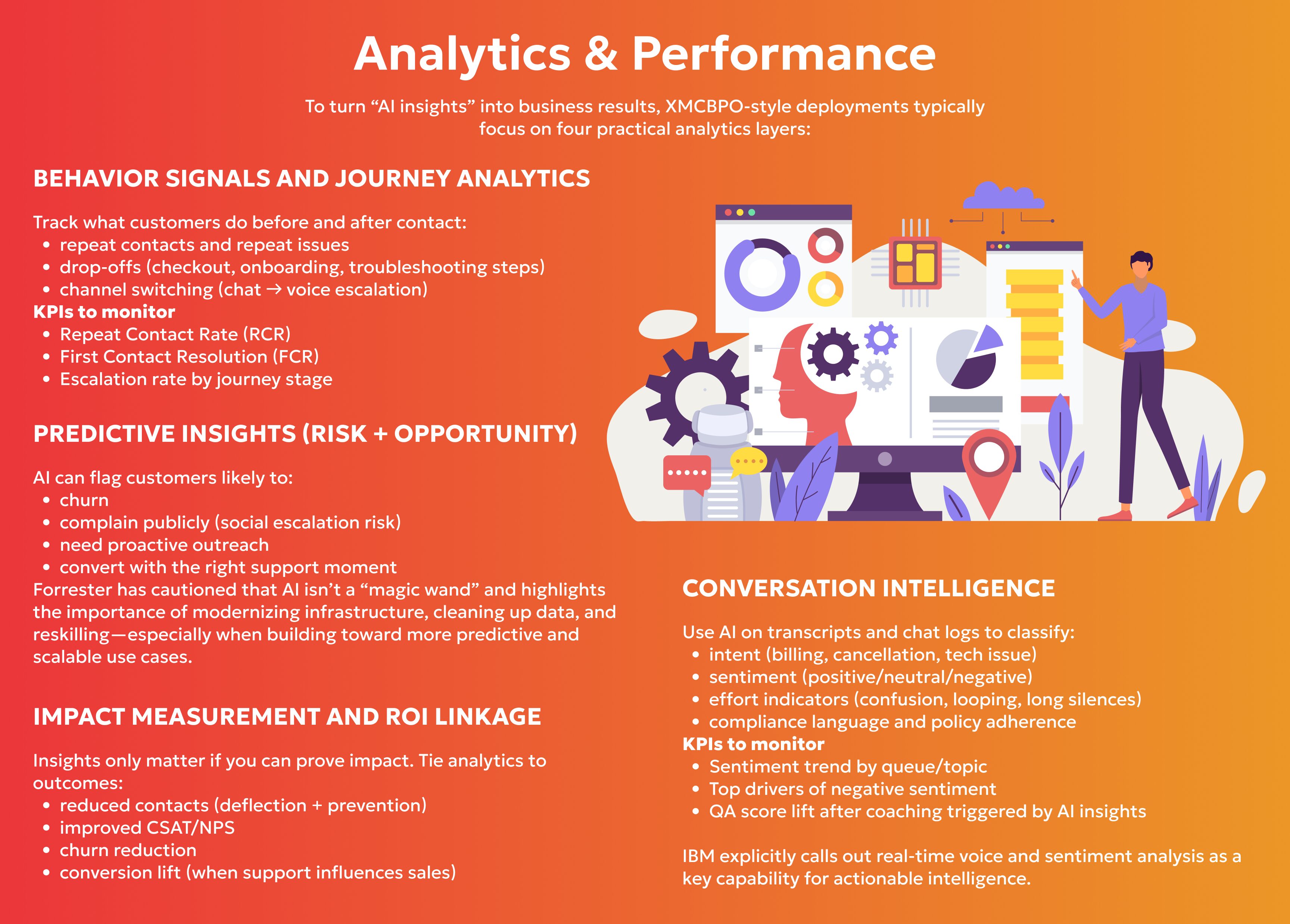
Customers are leaving signals everywhere—voice calls, chats, emails, social DMs, website clicks, app events, and even the “silent” moments when they abandon a cart or repeat the same question. What’s changed is our ability to connect those signals and extract meaning at scale.
With AI-powered analytics (including real-time sentiment and intent detection), contact centers can move beyond basic reporting into behavior intelligence—predicting needs, reducing friction, and improving outcomes across the entire customer journey. For providers like XMCBPO, AI-driven insights turn frontline conversations into a continuous engine for better CX, smarter operations, and measurable business impact.
Key Benefits

Deeper customer understanding across channels
AI can unify structured data (CRM fields, handle time, dispositions) with unstructured data (call transcripts, chat logs, social messages), creating a clearer view of:
- why customers contact
- what they’re trying to accomplish
- what causes frustration or churn risk
This lets XMCBPO teams tailor support journeys to actual behavior, not assumptions.

Real-time intent and sentiment detection
Modern tools can analyze language patterns and conversational signals in real time to surface:
- rising frustration
- cancellation intent
- confusion with policy or product steps
- “high value” customer moments that need priority handling
IBM specifically highlights real-time voice and sentiment analysis as a key direction for contact center automation in 2026.

Personalization that scales (without losing control)
AI can recommend next-best-actions, responses, and knowledge articles based on the customer’s context—helping agents deliver consistency while staying human.
McKinsey notes that realizing value from AI at scale depends heavily on operating model, data discipline, and adoption practices—not just tooling. That’s where structured execution (like XMCBPO workflows + QA) matters.

Better service outcomes—when AI is used responsibly
AI isn’t automatically a CX win. Research and analyst commentary emphasize that poorly implemented AI can erode trust and expose broken processes faster. The edge is using AI to support agents and processes—not simply replace them.

Conclusion
AI-powered insights are changing contact centers from reactive support teams into customer behavior intelligence hubs. When implemented with strong data discipline, responsible governance, and agent enablement, AI helps businesses understand what customers need—sometimes before customers say it.
For XMCBPO, the opportunity is clear: use AI to translate omnichannel interactions into actionable insights, then turn those insights into measurable improvements in customer experience, operational efficiency, and growth.
References
- IBM. A guide to contact center automation trends for 2026
- McKinsey & Company. The state of AI in 2025: Agents, innovation, and transformation
- McKinsey & Company. Unlocking the next frontier of personalized marketing
- Forrester. Why AI Isn’t The Silver Bullet For Customer Service — Yet
- Gartner. Customer Service AI: Home in on High-ROI Use Cases


