
“Agentic AI” is the buzzword of the moment—but in customer service, the difference between hype and results is simple:
- Hype = a bot that talks like a human.
- Operational wins = an AI “agent” that can plan, decide, and take actions across systems (within guardrails) to resolve issues end-to-end.
In 2026, many customer service leaders feel real pressure to implement AI. That pressure is pushing teams toward agentic approaches—but only the teams that treat agentic AI as an operating model change (not a chatbot upgrade) will see measurable CX gains. This is where an execution partner like XMCBPO can help: aligning workflows, governance, QA, and analytics so “agentic” becomes reliable service delivery, not a risky experiment.
Key Benefits

Real end-to-end resolution (not just “answering questions”)
What’s hype: AI that provides a nice response, then hands the work back to customers or agents.
What wins: AI that can complete tasks like:
- checking order status across systems
- initiating returns/refunds (with approval rules)
- updating customer info
- opening/closing tickets with the right disposition and notes
- triggering follow-ups automatically
This “AI that acts” is a key promise of agentic AI in service operations.
XMCBPO angle: XMCBPO can implement agentic workflows where AI handles the repetitive execution steps while agents handle exceptions and empathy-heavy cases.

Faster service without sacrificing experience
Agentic AI can reduce time-to-resolution by:
- auto-triaging intent and priority
- pulling context instantly (customer history, past tickets, policy rules)
- pre-filling forms and generating summaries for agents
But the win depends on good design: AI should remove friction, not create dead ends—especially since customer trust can drop if AI feels like a blocker to human help.
XMCBPO angle: Design clear “escape hatches” (human escalation) and train agents for higher-value resolution—so speed doesn’t reduce quality.

Better agent productivity through “digital teammate” support
Even when AI isn’t customer-facing, agentic AI can operate like a digital teammate:
- surfaces next-best-actions
- recommends knowledge articles
- drafts responses and wraps
- triggers back-office steps in the background
This supports more consistent outcomes while reducing after-contact work—when governed properly.
XMCBPO angle: Standardize how agents use AI (playbooks + QA checks), so productivity gains are repeatable across teams.

Stronger governance and lower operational risk (if done right)
The biggest agentic AI failure mode isn’t “bad language”—it’s bad actions (wrong refunds, incorrect account changes, compliance slips).
Real wins come from guardrails:
- scoped permissions (“what actions can this agent take?”)
- approval workflows for high-risk actions
- full audit logs
- grounded knowledge sources (not freeform guessing)
This is increasingly emphasized across major platform and analyst perspectives on customer service AI
XMCBPO angle: Implement governance-as-operations: QA, compliance monitoring, escalation rules, and incident management for AI.

Conclusion
Agentic AI in customer service is not a magic switch. The hype is thinking “autonomy” automatically equals “better CX.” The real operational wins come when agentic AI is treated as a managed production system:
- clear workflow boundaries
- trustworthy data + grounded knowledge
- human escalation and approvals
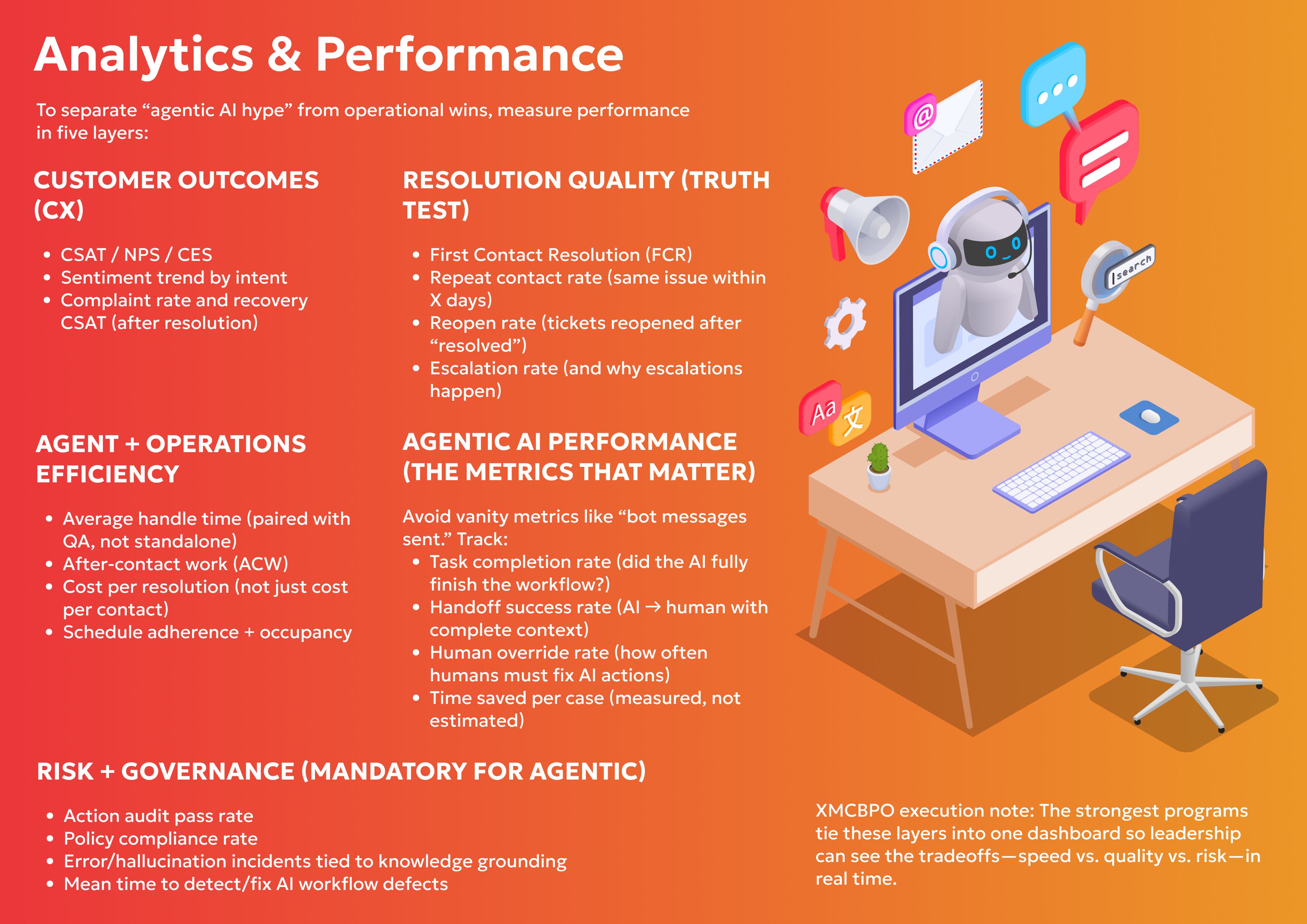
- measurable outcomes (FCR, CSAT, cost per resolution)
- governance that prevents costly mistakes
For teams aiming to deliver this at scale, XMCBPO can help translate agentic AI from a concept into a stable operating model—where AI accelerates resolution and humans protect trust.
References
- McKinsey — The future of customer experience: Embracing agentic AI
- Google Cloud — What is agentic AI?
- Gartner — Customer service AI: Hone in on high-ROI use cases
- IBM — Contact center automation trends
- Vonage — Agentic AI in contact centers


