
In 2026, Workforce Management (WFM) and Workforce Optimization (WFO) are no longer “back-office tools.” They’re becoming real-time operating systems that continuously rebalance staffing, protect service levels, and improve agent experience—powered by AI, automation, and unified platforms.
For teams scaling fast (or supporting multiple clients/programs), XMCBPO can use these trends to deliver a stronger promise: right staffing + better performance + healthier teams, backed by measurable governance and operational discipline.
Key Benefits

AI-powered forecasting becomes continuous (not monthly)
Forecasting is shifting from “historical averages” to AI models that account for more variables (seasonality, events, channel mix) and help produce more accurate interval-level demand predictions.
XMCBPO impact: fewer staffing surprises, fewer SLA misses, better cost control across campaigns.

Intraday automation moves from reactive to proactive
Intraday management is becoming more automated—detecting shortages/surpluses and triggering schedule actions (OT, VTO, skill moves, micro-shifts) fast enough to protect SLAs in the same day. NICE explicitly frames intraday scheduling as real-time adjustment to handle volume fluctuations.
XMCBPO impact: smoother peaks/valleys, less “panic staffing,” and fewer burned-out agents.

Scheduling gets more flexible (and more employee-friendly)
2026 WFM is increasingly designed for flexibility + employee self-service (shift swaps, time-off requests, preferences) while still enforcing compliance rules and staffing constraints.
XMCBPO impact: better adherence and retention—especially in high-churn programs.

WFO becomes “unified”: WFM + QA + coaching + performance in one loop
Modern WFO is increasingly positioned as a connected suite: forecasting/scheduling plus recording, QA, coaching, and performance management—so workforce decisions tie directly to quality and outcomes.
XMCBPO impact: staffing plans reflect actual handle behavior and quality drivers (not assumptions).

Vendor market momentum signals “AI WFM” is a priority
The ecosystem is consolidating around AI-driven WFM. For example, RingCentral expanded its contact center stack by acquiring CommunityWFM and highlighted AI-driven forecasting, scheduling, and real-time adherence as core capabilities.
XMCBPO impact: clients will increasingly expect WFM maturity as part of modern CX delivery.

Conclusion
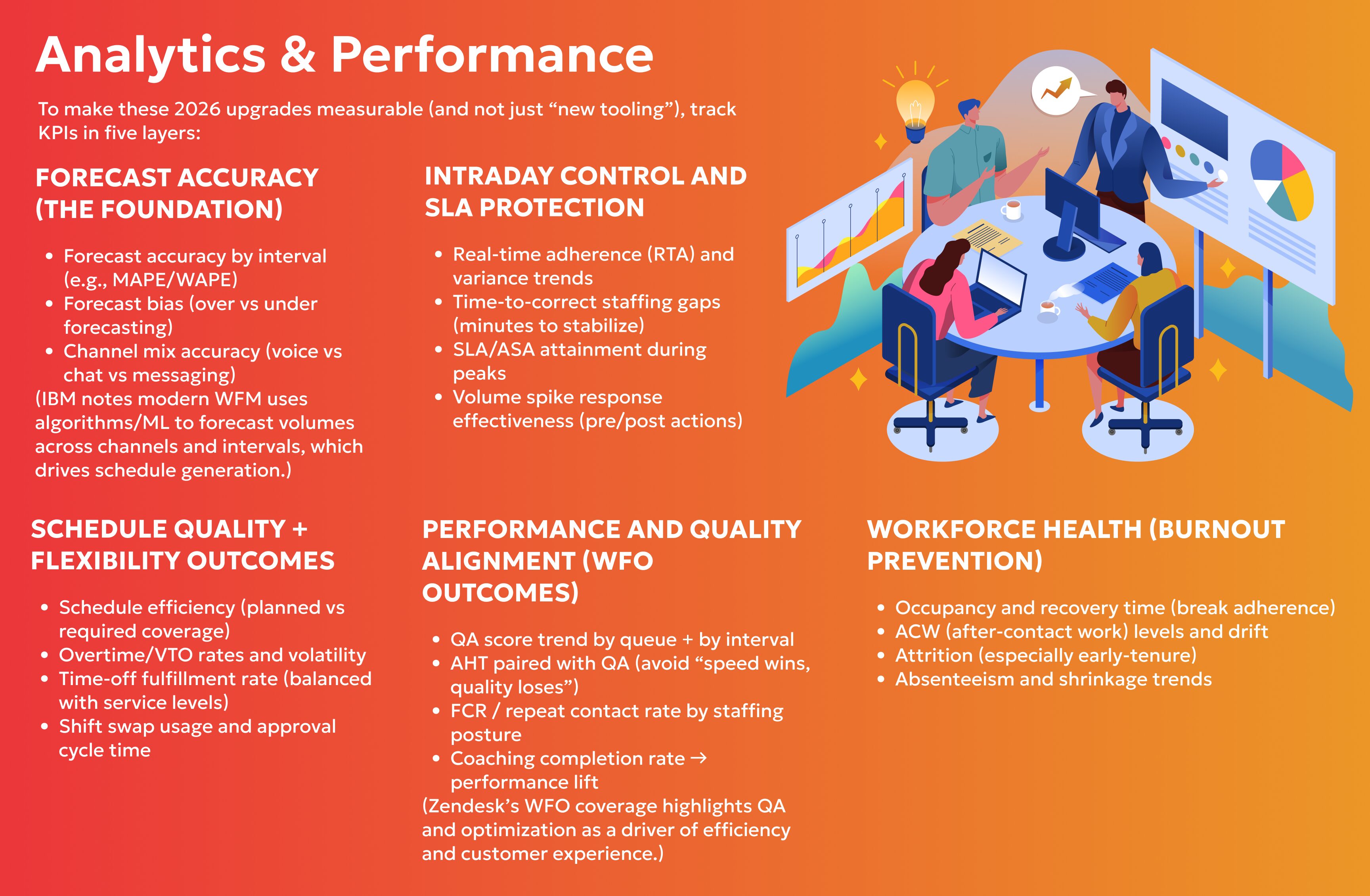
In 2026, WFM/WFO is being “upgraded” from static planning into AI-assisted, real-time orchestration—combining forecasting, intraday automation, flexible scheduling, and integrated performance loops.
For XMCBPO, this is a strategic edge: using modern WFM/WFO practices to deliver stable SLAs, consistent QA, and healthier teams—with dashboards that prove impact across cost, experience, and retention.
References
- Aspect. 10 WFM trends shaping 2026
- IBM. What is contact center workforce optimization?
- NiCE. Unlock workforce management potential
- NiCE. What is Intraday Scheduling?
- Genesys. Get accurate workforce forecasting and flexible scheduling
- Genesys. About workforce management
- Zendesk. Workforce optimization: The ultimate guide for 2026
- ChannelPro. RingCentral expands contact center capabilities with CommunityWFM acquisition


