
AI is now embedded across customer service—chatbots, agent assist, auto-summaries, knowledge search, and workflow automation. But in 2026, the core differentiator isn’t “who has more AI.” It’s who earns trust while using AI.
That matters because customers are skeptical: recent research shared by Pega (via Business Wire) says two-thirds (66%) prefer human-led support, and 77% say they often get better outcomes with humans. Meanwhile, leaders feel major pressure to implement AI—Gartner reports 91% of customer service leaders are under executive pressure to do so in 2026.
For service providers like XMCBPO, trust becomes a competitive advantage: deploy AI to improve speed and consistency—while keeping transparency, escalation, and human oversight rock-solid.
Key Benefits

Transparency reduces frustration and protects the brand
Customers want to know when they’re talking to AI—and what AI can/can’t do. Clear disclosure and accurate expectations prevent:
- “I thought this was a person” backlash
- looping conversations
- misguided trust in incorrect answers
This aligns with broader AI governance expectations (and growing regulatory scrutiny).
XMCBPO SEO angle: XMCBPO can operationalize transparency through channel scripts, bot UX standards, and QA checks that ensure disclosures are consistent across chat, email, and messaging.

Escalation pathways prevent “AI dead ends”
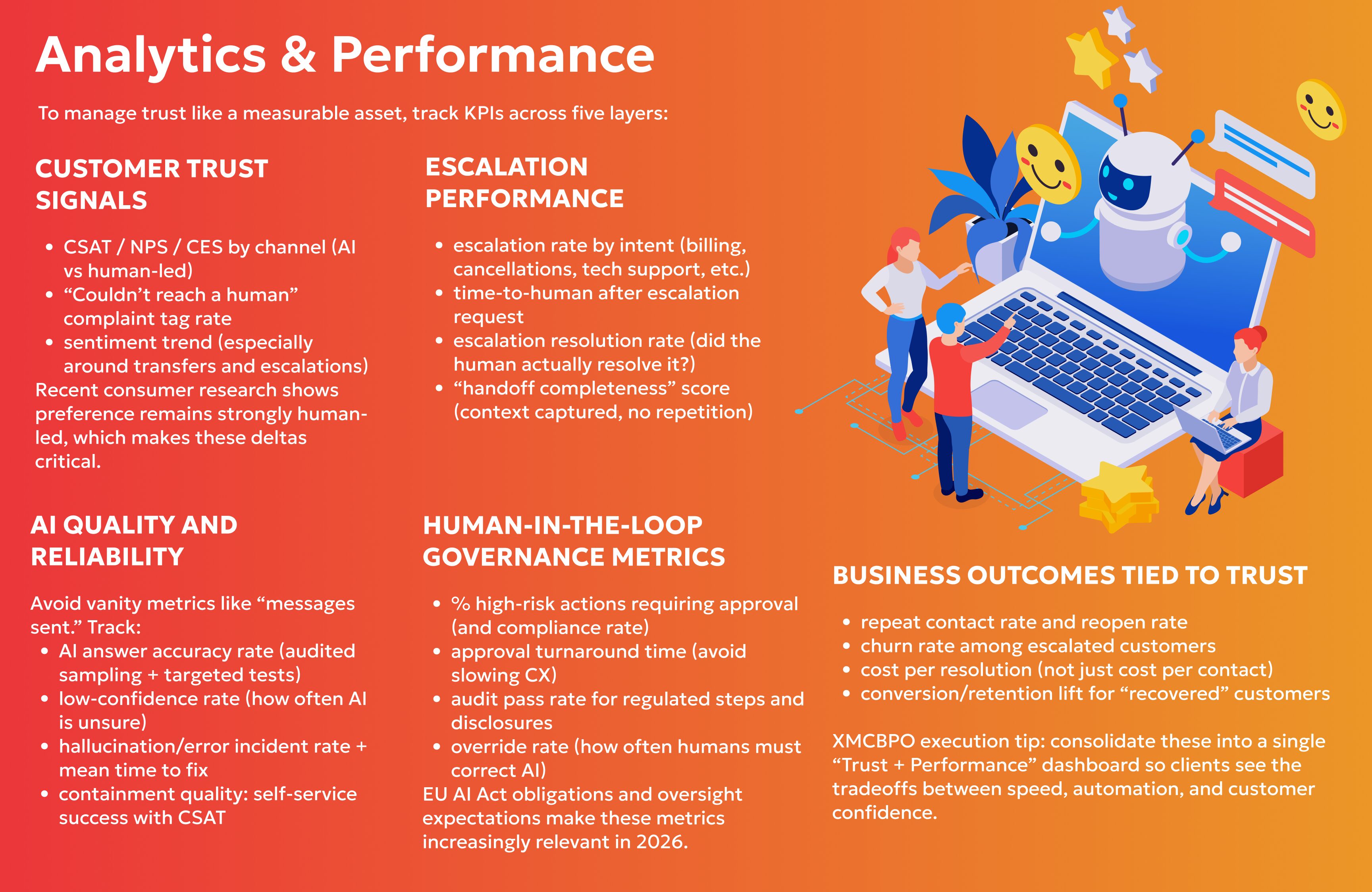
The #1 trust-killer is when AI becomes a barrier to help. Recent reporting on consumer sentiment shows people distrust AI customer service when outcomes are poor or when access to humans is restricted.
A strong escalation design includes:
- one-tap “talk to a human” for sensitive issues
- escalation triggered by low confidence / negative sentiment
- priority routing for high-value or high-risk customers
XMCBPO SEO angle: XMCBPO can implement escalation playbooks (routing rules + staffing + QA) that keep service fast and human when needed.

Human-in-the-loop improves accuracy and reduces risk
“Human-in-the-loop” isn’t just a philosophy—it’s an operating model. The best AI contact centers use automation for repeatable tasks while humans own exceptions, emotion-heavy calls, and complex cases.
Where HITL matters most:
- refunds, cancellations, disputes
- identity verification and fraud risk
- regulated disclosures and compliance steps
- policy exceptions and goodwill credits
This also aligns with the EU AI Act emphasis on human oversight (especially for high-risk systems) and the timeline that makes the Act fully applicable on August 2, 2026 (with phased obligations).
XMCBPO SEO angle: XMCBPO can design approval workflows (AI proposes → human approves) and audit trails that reduce costly mistakes.

Trust-first AI improves adoption internally (agents + supervisors)
AI doesn’t deliver ROI if agents don’t use it or don’t trust it. When AI is governed, accurate, and helpful, it drives:
- higher agent assist adoption
- more consistent QA performance
- reduced after-contact work via trustworthy summaries
Conclusion
In the AI era, trust is engineered—not assumed. The brands that win in 2026 will be the ones that treat transparency, escalation, and human-in-the-loop oversight as non-negotiable CX design principles.
With the right operating model, XMCBPO can help organizations deploy AI responsibly—improving efficiency and consistency while protecting customer trust through clear disclosures, reliable escalation to humans, and governed decision-making.
References
- Gartner: 91% of customer service leaders under pressure to implement AI in 2026
- Pega research (Business Wire): consumers prefer human-led support
- ITPro: why customers distrust AI chatbots
- European Commission: EU AI Act timeline (full applicability Aug 2, 2026)
- ArtificialIntelligenceAct.eu: Article 26 (human oversight obligations for deployers)
- CX Today: how AI contact centers work (human-in-the-loop design)
- Reuters: EU guidance for systemic-risk AI models and compliance by Aug 2026


