
For years, contact center quality programs depended on QA sampling—reviewing a small percentage of interactions and hoping it represented reality. In 2026, that model is being replaced by QA automation: AI-driven transcription, scoring, and analytics that can evaluate nearly every voice and digital interaction, uncover trends faster, and reduce inconsistency across evaluators.
For delivery partners like XMCBPO, automated QA doesn’t remove the human role—it upgrades it. Supervisors spend less time hunting for “bad calls” and more time coaching behaviors that move CSAT, FCR, and compliance outcomes.
Key Benefits

Visibility beyond the “1–3% problem”
Manual QA typically reviews only a fraction of total interactions, creating blind spots and bias. Automated QA can analyze far more conversations to give leaders a complete performance picture and surface coaching opportunities earlier.
XMCBPO advantage: consistent visibility across teams, accounts, and shifts—especially in high-volume programs.

Faster coaching loops (coaching in days, not weeks)
AI-driven evaluation can identify patterns and behaviors quickly (empathy, compliance steps, dead air, escalation signals), enabling near-real-time feedback instead of delayed monthly calibration cycles.

More consistency by reducing evaluator subjectivity
Platforms increasingly use AI-generated score data and objective behavior models to standardize evaluation and make coaching more consistent.
That doesn’t eliminate human judgment—it targets it where it matters: exceptions, nuanced context, and high-impact interactions.

QA expands beyond voice to true omnichannel quality
Modern quality programs require coverage across voice and digital channels. Many systems now support speech and text analytics that can analyze large volumes of customer-agent conversations and provide detailed insights.
XMCBPO angle: one QA framework across voice + chat + email + messaging improves consistency and makes performance management simpler.

Better compliance monitoring at scale
Automated approaches can flag compliance risks (missing disclosures, authentication steps, prohibited promises) at scale, reducing regulatory exposure and protecting brand trust.

Conclusion
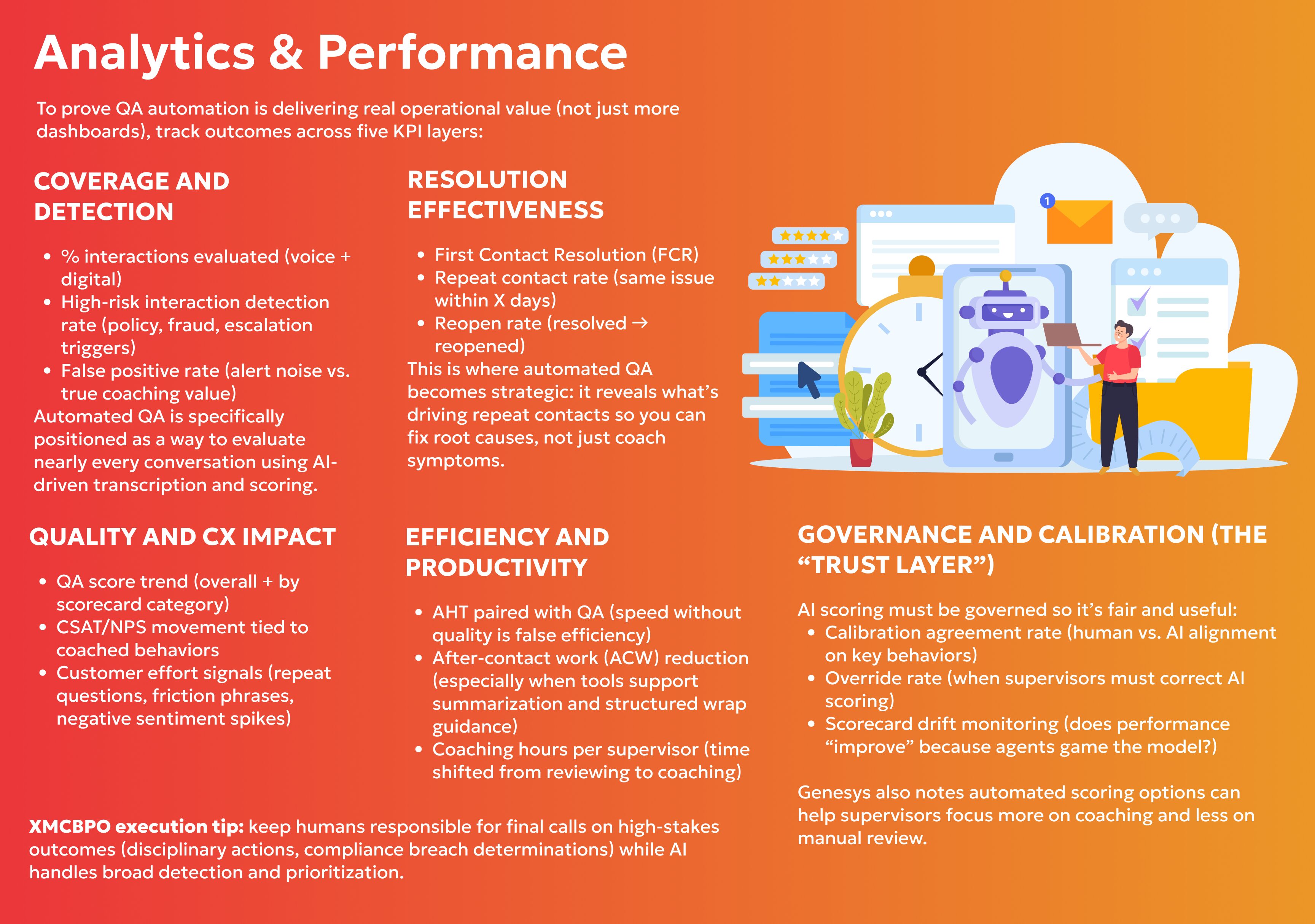
QA automation in 2026 is not about replacing QA—it’s about replacing sampling. AI makes it possible to evaluate far more interactions, reduce subjectivity, find coaching opportunities faster, and scale compliance monitoring across channels. The best programs combine AI’s coverage with human judgment for nuance and fairness.
For XMCBPO, the opportunity is to deliver a modern quality operating model: automated detection + structured coaching + measurable CX outcomes—so quality management becomes a growth lever, not a bottleneck.
References
- Genesys. Automated quality management (AQM)
- Nice. Turn every conversation into a chance to improve
- CallMiner. What is call center quality assurance and how can automation improve it?
- CallMiner. Drive better quality outcomes in the contact center and improve CX
- Genesys. About quality management
- Genesys. Automated scoring options in evaluation forms
- MaxContact. Using AI Speech Analytics for Quality Assurance (QA) in Contact Centres


